martes, 19 de octubre de 2010

The rise of MNCs

At this stage of the course, in order to understand how the corporations act, and the impact of their actions in the society we saw "The Corporation". The Corporation is a documentary directed by Mark Achbar and Jennifer Abbott, who goes into the psychopathic business world. Is based on the book entitled 'The Corporation, the pathological pursuit of profit and power', by Joel Bakan.

The documentary begins by explaining the enormous power that was given to corporations by giving them the rights of a person. But if corporations have the same rights as a person, what kind of person is the corporation? Over the years we have seen the last of these entities interest was wealth, profit above the good of the society, people use to describes corporations as constructive members of the society, because they produce goods we need for daily life, besides offering employment to the community. But we can’t forget that the primary goal of a Corporation is the money, they have a profit motivation.

Every action implies a sequel, but who bears the consequences of the actions of corporations? Experts use the word "externality", Milton Friedman describes it as the effect of a transaction between two parties on a third party who is not involved in the transaction. One of the interviewees summarized this way of behaving in a simple sentence, but worrisome, " let somebody else deal with the problems the corporation creates… let someone else take care of it".
The corporation can then be described as an “externalizing Machine”. The documentary describes cases in which externalities listed as: Harm to workers (Union busting, layoffs, factory fires, sweetshops), harm to human health (with dangerous products, emission of pollution and toxic waste, and using synthetic chemicals), harm to animals (through habitat destruction, factory farming and experimentation) and harm to biosphere (through clear-cuts, CO2 emissions and nuclear waste). The damage done to the world is becoming the only legacy for future generations.

But going beyond the documentary assesses the behavior of corporations, and as these are considered as a legal person, as his acting, and using a personality diagnostic checklist by the World Health Organization, it is concluded that corporations have a psychopath behavior. This conclusion begs the question, Who controls the balance of corporate behavior?.

Another important issues highlighted in the documentary is privatization, the way in which public goods such as water, are being privatized and managed by corporations. The directors of the documentary lead us to ask whether we can trust in a corporation to manage public goods through the Pfizer case. Pfizer's policy is to "make the community better” therefore has its own traffic private transit security system. When there is a demonstration of this system for the cameras, the results are counter to the policy described.

Many of the cases discussed in the documentary are serious and disappointing; to see how the power is given to corporations have been allowed to act as they wish. But people have begun to notice, there are critical views that are raising their voice against the corporations and the indiscriminate use of resources. The union of the people is perhaps the only way to stop the psychopaths.


To view the documentary clicks the following link:
http://www.youtube.com/view_play_list?p=FA50FBC214A6CE87

Questions

1. Do Corporations pursue today other interest or the "bottom-line" remains as their single priority? what are the factors influencing the corporation’s objectives and goals?

“It is difficult to write about the growth of multinational corporations (MNCs)3 without yielding to stereotype. On the one hand, there is the image of the modern business enterprise, staffed by highly competent managers, working at the cutting edge of technology to overcome logistical challenges and bring improvements to human life. On the other hand is the increasingly pervasive picture of the transnational corporation as the behemoth of modern life — large and powerful enough to control governments while engaging in big brother social control of consumers and unchecked exploitation of people in developing countries. Both stereotypes invoke the large size and important economic impact of MNCs.” (1)

So it is difficult to answer this question, especially after seen the documentary, because it expose a very negative perspective. I believe that as many of the corporations in the world respond to what Michael Moore says, that at the end corporations seek to make as much money as possible and the real problem is the profit motivation and to understand when enough is.

But I think the desire of consumers to learn more about the products they consume or the goods and services that are part of daily life are exerting significant pressure, forcing corporations to build processes and protocols aimed at social responsibility and sustainable development.

“Chocolate manufacturers in Europe devised ethics codes and built model factories to the benefit of their workers, supplied health and adult education facilities and reduced the length of working week.In the USA pharmaceutical such as Merck developed Codes of conduct, which underlined the Corporation’s goal to serve public health. These two are just a sample of Corporations’ respect for constituents other than shareholders” (2)

Without a doubt I think we are learning from past mistakes, and there are corporations that are changing their ways of act.

2. The film focuses on the negative consequences that the Corporation’s behavior cause to the environment, to human health and animal life. Discuss from a critical perspective, the possible benefits and arising from the actions of MNCs for these 3 groups.

Some of the analyses made by the interviewees have in common the concern to know what we are leaving to future generations.

The documentary shows several images that reveal the damage that corporations are causing to the environment, such as the indiscriminate abuse of exhaustible resources like water and oil, and use of pesticides and toxic substances have caused havoc on the flora and fauna of the world. Global warming, the extinction of species, starvation and birth defects are just some of the consequences we face.

“In recent years, MNCs have increasingly been accused of engaging in polluting or environmentally degrading activities through their subsidiaries, particularly in developing countries. Human rights groups and local communities have done much to highlight instances of pollution or illegal resource depletion, and often allege that these activities are linked to MNC collaboration in violating human rights”. (3)

Privatizing public elements and turn them into a private business has left a big profit corporations. Animal testing may have led corporations to great discoveries, and the dismissal of workers may have saved many companies from bankruptcy. No clutch, endangering the life and the world is destroying the future for all.

3. Do you think a corporation should be considered a "person"? discuss the implications and limitations of granting such legal existence to corporations.

I do not think corporations should have the same rights as a person. As Dr. Vandana Shiva (Physicist, Ecologist, feminist and seed activist) says in the documentary, the Corporation is not a person, because it doesn’t think, people think, the individuals of the corporation are those who think. Corporations do not have feelings, do not breathe and think, how they can be considered part of "us".

No doubt the corporations gain too much power when they are granted the same rights as a person. But a corporation faces the same consequences as a human being to commit a crime?
When we have seen a corporation in jail, a corporation facing the death penalty? or otherwise, upon the coming of economic crisis in the United States some corporations receiver government financial aid even though it was these same corporations were the ones put at risk the economy of a country, the same thing would happen if a citizen threatening the stability of a country, would receive economic aid from the government?

This makes me conclude that we can not give the same treatment to corporations and individuals because simply they are not the same.

References

(1) Michael Anderson (2002), Transnational Corporations and Environmental
Damage: Is Tort Law the Answer?. Pag 2

(2)Elena F Pérez Carrillo (2007) Corporate Governance: Shareholders’ Interests’ And Other Stakeholders’ Interests. Universidad Santiago de Compostela.

(3) Michael Anderson (2002), Transnational Corporations and Environmental
Damage: Is Tort Law the Answer?. Pag 4

Kline, John M. 2006. "MNCs and Surrogate Sovereignty." Brown Journal of World Affairs 13, no. 1: 123-133.

The Corporation, a documentary made by Mark Achbar and Jennifer Abbott. http://www.youtube.com/view_play_list?p=FA50FBC214A6CE87
Images taken from:

http://wideawareness.files.wordpress.com/2010/02/41980_the_corporation.jpg
http://www.cccb.org/rcs_gene/07_corporation_1.jpg

martes, 5 de octubre de 2010

Merging organizational cultures


To work this issue of course, use the text: "Challenges and Opportunities in Mergers and Acquisitions: Three International Case Studies - Deutsche Bank-Bankers Trust, British Petroleum-Amoco, Ford-Volvo." This reading informs the experiences and lessons from the situations that arise in mergers and acquisitions, analyzing each case.

It is the Common Knowledge That mergers and acquisitions are strategic solutions that improve the company's position in the market, also represent a source of knowledge and learning opportunity. No clutch, are also difficult decisions, which, not being managed properly can jeopardize the stability and future business of an organization.

The paper explains that what is really important when making a decision that ends in a Merger and Acquisition (M&A) should be taken into account the creation of value, since this is the goal. But that value is not created until capabilities are transferred.

To understand the possible situations in a process of integration, the term acculturation is exposed, the text takes the term proposed by Malekzadesh, that means: "The changes resulting from the interaction of one organizational culture with another, or: ... the ways in which two groups adapt to each other resolve emergent conflict ".

The text is very clear explaining that two companies can effectively integrate, ie, combining two companies into one group, resulting in joint efforts to conquer the objectives of the new organization, despite cultural differences, as long as they consider two aspects, the need for individuals to have a strategic independence between firms, and the need for organizational independence.

Another factor to consider is to give importance to the process of integration, not only to the transaction as such, but the process that connects the two companies. Therefore, through the three cases of effective integration, the authors showed common characteristics, such as the creation of integration teams who worked actively in the process, the commitment of the executives and the role they play as guides for the rest of the company in order to manage the uncertainty, the identification of the aspects that differentiate firms and commonalities between them, the statement of common goals, and strengthening the common identity.

In conclusion, it argues that a successful integration is possible when the benefits are designed after an effective acculturation process.

Questions

Based on the required reading for this module, list and explain - using evidence from the cases presented in the reading - the main challenges and opportunities arising in processes of mergers and acquisitions from an organizational culture perspective.
Include at least 3 challenges and 3 opportunities.

In the cases presented in the text assigned for this topic, one can see several opportunities and challenges, which I'll go looking for cases.

• Case 1: Integrating Deutsche Bank (DB) and Bankers Trust (BT)

This case presents three main challenges. The first is to convert a German bank in a global organization, so which one of the strategies was precisely the integration. About that, Rolf-E. Breuer, Spokesman of the Board of Managing Directors of Deutsche Bank, said: "The strengths of Bankers Trust allow Deutsche Bank to place its globally-orientated business areas on a transatlantic platform. After the combination with Bankers Trust, Deutsche Bank will stand for innovation, financial strength and client focus on both sides of the Atlantic. Our assets are outstanding human resources in all parts of the world, excellent products and a strong brand name. Deutsche Bank operates successfully as a multi- specialist for financial services and will stay on course for expansion. Deutsche Bank will be able to satisfy its customers' wishes even more successfully on a global level. It will thereby secure and create qualified jobs. With its forward-looking strategy, Deutsche Bank is laying the foundations for long-term growth in company value for shareholders." (PR Newswire, 1999)

Another challenge is the internal conflict that existed between BT Alex Brown, Alex Brown employees felt they had lost their identity, thus, the name given to the company resulting from the integration was: The Deutsche Bank - Alex Brown Investment Bank, so not only reinforced the brand, identity also remained. The third challenge I think is important was to overcome the opinion of BT employees to DB. It was thought that DB was a rigid company, with a strong bureaucracy, hierarchical, and with a slow decision making process. The executives then decided to hold the views that BT had on the DB as a way to challenge employees to improve their work.
One of the exciting opportunities posed by this case integration is Alex Brown, the Oldest U.S. investment bank. Using the image of this institution was to play the card of confidence, experience and knowledge, as Alex Brown reached to meet 200 years before being acquired by BT.

• Case 2: Integrating British Petroleum (BP) and Amoco into a single organization.

The main challenge posed by this case is the main challenge for any integration of companies with different cultures, building a new corporate culture. To this end, several meetings took place with about 500 managers, where they explained the philosophy of BP and led participants to socialize among themselves.

• Case 3: Volvo and Ford.

In the automotive industry, technology is one of the tools that make a difference; this was the main chance with the integration of these companies, the technology transferred. As a result of the integration Volvo and Ford engineers visited the various plants, shared knowledge on topics such as safety, ergonomics, among others.

Another opportunity is given to the integration of Volvo and financial power, because Volvo “needed money to develop new models in order to stay competitive in the world market where its 400 000 sold cars per year constituted a modest one percent of total world sales” (Buerke, 1999).

One of the major challenges is the one that came with the contact between two totally different organizational cultures. Volvo Swedish culture was characterized by being decentralized and teamwork-oriented, while Ford's culture was characterized by being structured and hierarchical.
References:


• Alzira Salama, Wayne Holland, Gerald Vinten, (2003) "Challenges and Opportunities in Mergers and Acquisitions: Three International Case Studies – Deutsche Bank-Bankers Trust; British Petroleum-Amoco; Ford-Volvo", Journal of European Industrial Training, Vol. 27 Iss: 6, pp.313 – 321.

• Daniel Oxelman, Gustav Scott, Per Stohm (2008). “Strategic Fit in Mergers and Acquisitions, A Case Study of Volvo Cars”, JÖNKÖPING UNIVERSITY. 2008

• “Acquisition of Bankers Trust Successfully Closed; Deutsche Bank Expands in U.S.A.”, PR Newswire (1999)

Images taken from:

Managing change and conflict


To be actively involved in the world and the marketplace, organizations face a continuous change. That is why we speak of the organization as a dynamic entity. Change is a common way for a company to adapt, improve or evolve.

This module talks about two types of change, the change has been planned in advance, and the change that is imposed on the organization (regulations).

Whether any type of change, the reasons for which an organization transforms may vary, there are external forces and internal forces. External forces are those such as globalization, technology, diversity in the workforce, among others. The internal forces are described by the attitude and expectations of employees, and the situations and results derived by the crisis or financial loss.

Surely we can describe the change as inevitable and manageable. Companies often face competitive environments, where the improvement of products and the search of the process optimization is a constant. Likewise, individuals within the company are changing; who is now in command may not be in charge tomorrow. But all these variables or conditions may be modified and managed.

We can talk about small changes, such as those that occur when you upgrade the technological tools of a company. There are strategic changes, which are slightly larger, such as restructuring or entering a new business. Other changes are radical, like when the organization changes its core business.

To change, individuals often react in different ways. The unknown always involve some resistance at first. Individuals may express positive or negative feelings to change. Negative feelings are a normal response against what is a threat.

To address the change in a positive way, the leaders of the organization must increase and improve the communication, trying to express in an assertive and rational way what is happening in the business. Participation in the change is also a useful tool and demonstrates commitment. Another tool that is favorable is the support in the process, motivating and advising.


Questions

1. Ubuntu at the workplace:

• It’s Ubuntu present at the workplace, it there a link between this philosophy and organizational culture?

As the document: Building competitive advantage from Ubuntu explains, Ubuntu philosophy is manifested in many ways the organization. The language and communication, time management perspective, the way in which decisions are made, the importance of age and beliefs, are elements that are manifested in the organizations of South Africa regularly.

As the Professor Dani W. Nabudere saied in his text Ubuntu Philosophy. Memory and Reconciliation: “… Ubuntu philosophy, in its different settings, is at the base of the African philosophy of life and belief systems in which the peoples' daily-lived experiences are reflected”. This appreciation leads us to confirm that the African philosophy is present in the organization, as part of the individual's life.

As philosophy and way of life, Ubuntu is part of African culture and is part of the organizations whose members believe in this philosophy. This philosophy and organizational culture are linked, since the Ubutnu helps internal integration, because it allows members of the same organization know how to interact between them.

Ubutnu philosophy also provides stories, symbols and structures of power in the organization. As explained in the document proposed by the teacher and mentioned above, respect for elders, their knowledge and wisdom, determine to some companies operating in Africa, the way the organization is structured and how are awarded by within it.


• Please select and explain 3 aspects of organizational life that evidence the presence of Ubuntu at the workplace.
  • Organizational aspect which is evident in the Ubutnu philosophy is in the timing. Time is seen as a whole, not fragmented as in Western culture, is also an element that can cure. In Western culture we tend to say that "time is money", try to spend our time in large part to business and maximize our profits. In Ubutnu philosophy, rather than use the time to maximize profits in business, is used as a time to improve the lives of the community, even when harm personal finance.
  • Another aspect in which organizational philosophy is evident is in the decision making process. Not only seeks greater profitability for the organization, it seeks also to ensure the welfare of the collective. Rather than seek a consensus to maximize profitability for the organization, it seeks also to ensure the welfare of the collective. Making a decision is not only a democratic consensus; it is to get a result that favors the community.
  • Finally, another aspect that shows the presence of Ubutnu Philosophy is the way that individuals relate within the organization. Co-workers are seen as brothers or sisters, and are treated that way. The organization is seen in some form sa extended family, so apply the collective thought: "I blong, Therefore I am".

2. African Bank Miners Credit – case study:

This case study illustrates the main difficulties faced in a process of merging two companies and the role played by culture. It is very important that in this section, you try to build relevant links between the 2 readings and your research about change theory.


• Please identify and explain 3 strategies used by the acquiring company in order to facilitate the change process through the use of Ubuntu.

As we saw in class, some changes occurring in the organization are planned. This happened to African Bank Miners Credit when it bought a controlling stake in the National Union of Mineworker's (NUM's). This was a change of strategic character, it was a larger change.

The company had to find a way to harmonize the process of splicing, and therefore relied on the Ubuntu philosophy as it's common knowledge in the South African region. “The Ubuntu It is a traditional African philosophy that gives an understanding of us as human beings in relation with the rest of the world.” (1) That's why it becomes a way of explaining the change and the individual's relationship with the organization

One strategy was the presence of the drum in the organization. The drum is an example of how the Ubuntu philosophy and the organization are linked, in addition, the drum is also a symbol of communication, and communication is one of the strategies for managing resistance to change.

As a strategy to explain how they wanted to grow in the market, the Company use the history of the bird and the badger. In this way it was explained that in order to grow as an organization it was needed to work together. Additionally, this idea is also supported by the Ubuntu philosophy, which says that what is good for the individual is good for the group and vice versa.

To remember the strategy being carried out, and to improve the understanding of this, the organization used as a strategy to resort to storytelling, which is common in the Ubuntu philosophy also used what they called "Our Ubuntu" booklets where employees could contribute to the success of the company.


References:

Mangaliso, Mzamo. 2003. Building competitive advantage from Ubuntu. In Thomas, David Clinton, editor, Readings and cases in International Management: Across-cultural perspective.

(1) David Suze Manda (2009) “Ubuntu philosophy as an African philosophy for peace.”

Barney Erasmus, Ben Swanepoel, Marius Van Wyk, Hans Schenk (2003) “South African Human Resources Management: Theory & practice”, Third edition, pp. 363- 364


Images taken from:


http://blog.leadingresources.com/wp-content/uploads/2008/08/managing-change.jpg

http://www.the2ccompany.com/images/conflictmanagement.gif


viernes, 3 de septiembre de 2010

Management styles + leadership styles

Converge, Diverge, and the Japanese and Korean Management Style

To understand the theory of convergence and divergence is useful to resort to the case of Korea and Japan as a culture.

The management style in Japan should not be generalized, but for educational purposes, we tend to think in this culture as a culture focused on strengthening its market share, looking to grow as a company, using economies of scale and be aggressive on price.

Suppliers in Japan are seen as a business partner, these partners will give the company good information. The active participation of employees is a feature in this culture that helps to increase loyalty to the organization. But perhaps one of the most important characteristics of management style in Japan is the importance they place on corporate values, as they help the organization to deal with change.

In Japanese culture, the "Zaibatsu" are groups of companies with family origins that accumulated power through the years. These groups are close to the government therefore receives special treatment, such as favorable tax policies. Another trait of the "Zaibatsu" is that banks may own, which can be a double-edged sword.

The management style of Korea is closely related to Japan, because Korea was occupied by Japan from 1910-1945. In order to face new market entry Korea adopted the Japanese model, using government intervention in credit, exports and foreign relations. As a result, they grew quickly and were able to diversify.

Like Japan, Korea also has a conglomerate of companies with family origins, which include a great power in the industries in which they participate. These business groups are called "Chaebol", but "Chaebol" has some differences with the Japanese model.

The "Chaebol" are not authorized to have banks, they use the government financing. This practice hurt Korea in the financial crisis in 1999, because companies could not pay their loans on time.

The Case of Japanese and Korean culture allow us to explain the convergence and divergence terms. Some cultures converge to meet the demands of international market and so to adapt, but at the same time preserve the main characteristics that make them special.

In the text what Makes Management Style Similar and Distinct Across Borders? Growth, Experience and Culture in Korean and Japanese Firms by Lee, Thomas & Choe, convergence is defined as: “theory that states that as countries develop management styles will tend to become more similar to those found in developed nations”.

1. List the main similarities and differences of Japanese and Korean management styles.

Answer: The similarity in Korea and Japan in their management style begins with recognizing the growth and internationalization as one of the major purposes of the organizations. Another of the similarities is related to the organization's relationship with suppliers. Both cultures see providers as a trading partner. Both the Koreans and the Japanese value the suggestions of their employees, employee participation is an important tool that both cultures recognize.

Convergence of cultures is explained by the closeness they had in the Japanese occupation and the similar position that both countries have against the market.

According to Lee et al, the difference between these two cultures can be explained by the divergence in the hierarchy orientation and in the economic environment. Other difference is in the Technology development and manufacturing area. Korea recognizes the technology as an important tool to develop economies of scale, while Japan emphasized more on flexible manufacturing, cause they prefer to be able to adapt fast to market changes.

2 . What is isomorphism? Do you think organizations change management styles to adapt to the environment? Which environment is stronger: national environment or international environment?

Answer: In the document: Do organizational cultures replicate national cultures? Isomorphism, rejection and reciprocal opposition in the corporate values of three countries, written by Nelson, Reed E (2003) , Isomorphism is explained as the phenomenon of change in which “organization structures and practices must 'fit' the environment in which they are embedded”. The same text also said that “organizations must be isomorphic with their environments if they are to survive and prosper.”

As a personal opinion I think that organizations change their culture to adapt to the market, Carrefour, for example, change the way they sell to customers when they entered the Chinese market.

Define which dominated environment within an organization is almost impossible, because depending on the situation, an organization will have to change a few times its internal environment.

References:

• Do organizational cultures replicate national cultures? Isomorphism, rejection and reciprocal opposition in the corporate values of three countries. Nelson, Reed E.; Gopalan, Suresh (2003)
• World culture and Transnational Corporations. John Boli & Donjah Hartsuijker. Emory University


Communication + Virtual Teams


Communication


In the fourth module of the course the teacher introduce to us the communication and virtual teams’ topics.

Communication is a learned skill in which individuals share their idea or information. The information could take a lot of forms and could be interpersonal or made with help of the technologies.

The interpersonal communication is the base of a relationship and involves lots of elements like, the communicator, the receiver, the perceptual screens, and the message. There are also issues like the noise, encode, decode and feedback, that play an important role in the way individuals communicate.

Communication is an important topic for the organizations cause link employees and supervisors to shared information. That´s why is a sensitive aspect.

As a tool the way in which we interact with each others in an organization can be different. Depending on the approach used by the manager, you can sort the way they exercise their role in five:

• The expressive speaker: These type of managers peacefully express and share their thoughts, opinions, feelings. As a result, employees know what they can expect

• The emphatic listeners: These types of leaders focuses on the other, they are patients’ listeners, but don’t take responsibility for their actions.

• The persuasive leaders: this persuasive leaders, trying to promote interest in others to achieve a goal, instead of given orders.

• Sensitive to feelings leaders: they try to take critical perspectives that enable them to negative feedback in a confident way.

• Informative managers: They are willing to maintain open communication with employees.

The most important thing that leaders should keep in mind is how to maintain an effective communication, and the best way to do this is taking into account the principles of effective communication, which are:

• Clarity
• A specific objective (purpose of the message)
• A full understanding
• Consistency
• Completeness
• Feedback
• Time


Virtual Teams

Virtual teams are “team members who are geographically dispersed and who come together by way of telecommunications technology (e.g. video conferencing). Each team member may be located in a traditional office setting, but the offices are not proximate to one another” (Kurland & Bailey, 1999, p. 56). A virtual team is also called Geographically Dispersed Team.

This definition implied several virtual teams characteristic, those characteristics are:

• Geographically dispersed over different time zones
• Driven by a common purpose
• Enabled by communication technologies
• Involved in cross-boundary collaboration
• Not permanent
• Small team size
• Knowledge workers
• Members may belong to different companies

We could classify the virtual teams in four types, teleworkers, virtual groups, virtual teams and virtual communities.

Teleworkers are the ones that are outside the workplace and have a remote access to the organizations information. Virtual groups are a combination of teleworkers that have the same boss, and have independent tasks and activities. Virtual teams are the members of a virtual group interaction with each others, have common goals and are visible in the organization structure. Virtual communities are larger entities that participate and interact via internet and share a common purpose and norms.

Virtual groups have many advantages, are flexible, save time and money, and require strong coordination and good communication. But they have also disadvantages, such as requiring advanced technology, make it more difficult for training of individuals, require workers who do not have to be monitored closely, and involves the management of cultural differences.

Questions

Communication is a process that allows organizations to send/receive messages within their own boundaries but also to interact with outside entities (customers, suppliers, the media, etc.). Messages are send/received not only through oral and written statements, there are many channels and ways that need to be considered when discussing effective organizational communication. In that sense, the use of sounds has become increasingly important.

Based on the article “If Intercontinental were a sound…what would it be?”*, Please discuss the implications (potential advantages, disadvantages, challenges, etc.) of using sounds to send strategic messages. You need to integrate the use of key concepts relating to the topic of communication to support your answer.

Answer: As a personal opinion I think that communicating with sound despite being a novel approach, is also a limiting tool.

An organization is an entity that has many components, pass on the experience, commitment and purpose of the message through music is a difficult task. Furthermore, it would leave aside the possibility of playing with all the senses of the consumer or employee, to convey a clear and more vivid.

In the article Business Strategy to Employees of Melcrum Publishing, the author explains:”Communicating business strategy to employees in a compelling and engaging way is something all communicators strive for. Ultimately, employees who feel part of the ‘bigger picture’ and are pulling in the same direction will not only have a positive impact on the bottom line, but also give your company a competitive advantage.” But a clear limitation can be seen in the light of the principles of effective communication seen in class. A message through a melody can be ambiguous, not always send a clear goal, and do not give a general picture of the organization and message. But, the real problem of communication through sound is the subjectivity of the message.

But from another point of view, some common barriers to communication could be handled more adequately. The language in a melody might not be a problem to transmit a message. Another barrier that would be broken would be the vocabulary; undoubtedly the music goes beyond words. A melody can convey a feeling.

In the article Business Strategy to Employees of Melcrum Publishing, the author explains:”Communicating business strategy to employees in a compelling and engaging way is something all communicators strive for. Ultimately, employees who feel part of the ‘bigger picture’ and are pulling in the same direction will not only have a positive impact on the bottom line, but also give your company a competitive advantage.


References
Image taken from

viernes, 20 de agosto de 2010

Motivation

In this part of the course we focus on the motivation and the importance of this in the organization, as a managerial skill.

The Washington University defines motivation as: “the set of forces that cause people to choose certain behaviors from among the many alternatives open to them”. It´s important to underline that motivation is a goal oriented force.

Given its importance in human life, experts have developed several theories to explain the role of motivation in individual’s behavior, how to predict behavior through motivation, and how to influence the actions of one person with this tool. These theories are:

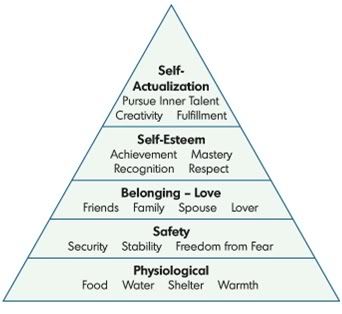
• Maslow's need hierarchy
• McGregor's Theory X and Theory Y
• Herzberg's two-factor theory
• Alderfer's ERG theory
• McClelland's need theory

The Maslow’s needs hierarchy theory assumes that individuals are motivated if their needs are met. This theory shows how the satisfaction of needs is given in a progressive manner, as shown in the pyramid (image 1):

The McGregor's Theory X and Theory talk about two types of hypotheses, the theory X and the Theory Y. Theory X talks about lazy employees that dislike work and responsibility. The employees describe by this theory are also self-centered and individualistic. On the other hand, the Theory Y assumes that the employees enjoy to work, seek responsibilities and are self sufficient. Both theories recommend how to deal with the workers. The Theory X recommends that these kind of workers need money as a motivation, while theory Y explain that the perfect motivation with the workers is to convert the goals organization into individuals needs.

The Herzberg's two-factor theory tries to explain how to manage the work satisfaction and dissatisfaction. Herzberg also introduced the hygiene factor. If an organization fulfills all the needs related with the hygiene factor, avoid the employee dissatisfaction, but this does not indicate that the employee will be satisfied.

The Alderfer's ERG theory comes from the criticisms of the theory of Maslow. The main difference is the idea that the needs can be met at the same time, so various levels of need can cause motivation simultaneously.
The last one theory is the McClelland's need theory. McClelland's explained that individuals manifest 3 needs. The need of achievement, the need of power, and the affiliation need. According to the needs, the author recommends how to motivate the person.

Questions

1. What are the Hawthorne Studies? Explain its importance for studying motivation at the workplace and its influence over diverse motivation theories. (Include key findings and limitations)

The Hawthorne Studies began as an experiment to measure if the lighting of the workplace increased employee productivity. This experiment result showed that illumination could affected the productivity improvement, concluded that workers improved their performance thinking they were being observed.

This effect is demonstrated as working conditions influence the behavior of the individual in the organization. This experiment showed how there are factors that motivate employees, and like The Herzberg's two-factor, other factors that involve only the employee to work without disgust but not with pleasure. Features such as lighting, moments of rest, and water, give comfort to the individual in his work area, but are not motivators, while the need for recognition, of belonging and empowerment are.

Another important finding relates to the role of manager or supervisor as a leader. That employees feel they are being studied can lead to two types of results, feel depressed or who feel they are a fundamental part of the organization. Everything depends on how the leader to communicate with subordinates.

The Hawthorne Studies are also related with the McGregor's Theory X and Theory Y. Cause understand what kind of workers integrated the organization is a fundamental key factor. Not all workers are motivated by the same things. As Elton Mayo discovered in the Hawthorne effect, pay is a relatively low motivator.


2. Based on the class activity about "Flight 001: Motivating Employees", please answer the following question: ¿Which motivation theory do you think has the most relevance for understanding the behavior of Griffin and fostering her motivation at work?

According to the "Flight 001: Motivating Employees" the theory that could explain better the success in the way that the organization is motivating their employees is the McGregor's Theory Y.
Emily Griffin is the perfect example of an employee that already fulfills the lower order needs, and is trying to fulfill the higher order needs. Ms. Griffin seeks for responsibility, new challenges, and the opportunity to improve her knowledge, and is totally capable of contribute to the organizational goals. That is why she is enjoying working in Flight 001.

As is described in Theory Y, the main source of motivation, for employees like Ms Griffin, is to contribute to the goals of the organization using their knowledge. Such workers enjoy meet their empowerment needs.


References


Image taken from:

Personality, perception and attribution

In the last week we started an interest topic relating with the behavior in the organization.
Perception, personality and attribution are characteristics that influence in a direct way the organizational behavior.

Perception is often compared with a pair of glasses, cause each individual understand, feel and see the world in a particular way. The perception is reflected in the way that a person act and behave. As Peter Lindsay and Donald A. Norman said in the book Human Information Processing: An Introduction to Psychology: “Perception is the process by which organisms interpret and organize sensation to produce a meaningful experience of the world… perception in humans describes the process whereby sensory stimulation is translated into organized experience.”

Frequently, the perception distorted the reality. People tend to leak information about events or situations experienced by selecting information from their environment. This leads the individual to change reality.

Personality, on the other hand, is defined as "An individual's pattern of psychological processes arising from motives, feelings, thoughts, and other major areas of psychological function. Personality is expressed through its influences on the body, in conscious mental life, and through the individual's social behavior." (Mayer, 2005)

Psychologist Fritz Heider (1896–1988) defined attribution in his 1958 book The Psychology of Interpersonal Relation as: “what people perceived and believed about what they saw dictated how they would act, even if their beliefs about what they perceived were invalid.”

A worker could attribute their performance in the organization to external factors in the environment or internal factors like knowledge. Judge the performance of a worker based only in one of these factors can have negative results in the motivation of the employee and in the organization.

References

• Peter Lindsay & Donald A. Norman: Human Information Processing: An Introduction to Psychology, 1977.
• Mayer, J. D. (2005). A classification of DSM-IV-TR mental disorders according to their relation to the personality system. In J. C. Thomas & D. L. Segal (Eds.), Comprehensive handbook of personality and psychopathology (CHOPP) Vol. 1: Personality and everyday functioning. New York, NY: John Wiley & Sons.
•http://www.referenceforbusiness.com/management/A-Bud/Attribution-Theory.html#ixzz0wKaWdKPI
• Heider, Fritz.The Psychology of Interpersonal Relations.New York: Wiley, 1958.
• Takao Inamori, Farhad Analoui, "Beyond Pygmalion effect: the role of managerial perception", Journal of Management Development, Vol. 29 Iss: 4, pp.306 – 321

Attitudes and values

Attitude is “a mental and neural state of readiness, organized through experience, exerting a directive or dynamic influence upon the individual's response to all objects and situations with which it is related” (Allport, 1935). This mean that attitudes are formed, the individuals are not born with the attitudes. Also means that our attitudes are reflected in our actions and reactions.
That is why attitude is related with evaluation, cause based on past experiences and a social learning, individuals evaluate a current situation an behave according to that evaluation.

Based on how we form our own attitudes is appropriate to say that another of the characteristics is that attitudes may change. Experiences in future situations and persuasion can change a person's behavior.

The Organizational Behavior studies are concerned with work-related attitudes and behavior. The employee’s attitude toward work can affect the job satisfaction, and the commitment with the organization.

Values are the set of ideas and beliefs of a group or a society. Values contain judgmental element as to what is right or not. Organizational values set standards of behavior in an organization, developing norms or guidelines.

Values provide the foundation for understanding a person’s attitudes, perceptions and personality, that’s why, is an important issue that explains the behavior of a person.


References

• http://users.ipfw.edu/bordens/social/attit.htm
• Gregorio Martín-de-Castro, José Emilio Navas-López, Pedro López-Sáez, Elsa Alama-Salazar, (2006) "Organizational capital as competitive advantage of the firm", Journal of Intellectual Capital, Vol. 7 Iss: 3, pp.324

Questions

1. Please explain, using your own words, the concept of Pygmalion Effect. What are the potential implications, uses, or challenges that this effect may pose for organizations engaging into international operations that require the understanding of diverse cultural contexts? Can you use this concept to explain the relationship between national and organizational cultures?

The Pygmalion Effect tries to explain how expectation interferes in the relations between the perceiver and the target. In other words, and applied to organization, when managers put their faith in an employee and believe that this organizational member could achieve something great, the person is more able to achieve a goal in a big way.

The theory also takes us automatically to think in the importance of trust as a motivational tool, cause managers play an important role in the organization, act as leaders, if they believe in their employees they are helping them to have a better performance. The Pygmalion Effect phenomenon talks about how people try to adapt their behavior to others expectation.

This phenomenon is easy to see in a work setting. “An employee’s quality of work and mind-set toward challenges depends on understanding what is expected of the employee. Understanding comes through example. Just as a new employee adapts and performs based on observing behaviors that are rewarded, existing employees will do the same in a culture-change initiative.” (Kathleen Goolsby, 2006)

In today’s international environment, organizations are more competitive, and success is more critical than ever. Leaders are the responsible of the environment and the team work results, that’s why motivation is a key factor.

In an international context different cultures meet, it happens in organizations. Making cultural differences do not affect the environment in the organization depends on what employees believe that their superiors expected of them.

As has been said by many, organizations have a special feature, are constantly changing, more so in an international environment. Workers must adapt to different circumstances almost every day, and understanding the Pygmalion Effect can make a difference. The way, in which organizational leaders communicate, motivate, and encourage their team work affect the work environment.

The Pygmalion effect also can explain the relationship between national and organizational cultures. An easy way to understand this is analyzing what happens when an employee is new to a company. The employee adapts its behavior according to what he/she see in the organization, although their performance is not that which dictates their national culture.

But, as the expectations you have on employees can be good, can also be bad. A negative expectation on the performance of subordinates may also affect the working environment. Also, the manager’s positive expectation does not enhance the performance of the worker. Those two cases lead the worker to feel discouraged and assign the result of what happened to external wedges.

As a personal opinion I believe that the expectations you have about someone and how that is communicated must be clear. Set high expectations and believe that a person can perform better than their capabilities allow them to, is a big mistake. As indeed is expected very little from someone who can give more.


References


Kathleen Goolsby, (2006) “Leadership Behaviors Can Hinder Corporate Goals”, Partnering Intelligence newsletter.

Takao Inamori, Farhad Analoui, "Beyond Pygmalion effect: the role of managerial perception", Journal of Management Development, Vol. 29 Iss: 4, pp.306 - 321