Motivation
In this part of the course we focus on the motivation and the importance of this in the organization, as a managerial skill.
The Washington University defines motivation as: “the set of forces that cause people to choose certain behaviors from among the many alternatives open to them”. It´s important to underline that motivation is a goal oriented force.
Given its importance in human life, experts have developed several theories to explain the role of motivation in individual’s behavior, how to predict behavior through motivation, and how to influence the actions of one person with this tool. These theories are:
• Maslow's need hierarchy
• McGregor's Theory X and Theory Y
• Herzberg's two-factor theory
• Alderfer's ERG theory
• McClelland's need theory
• McGregor's Theory X and Theory Y
• Herzberg's two-factor theory
• Alderfer's ERG theory
• McClelland's need theory
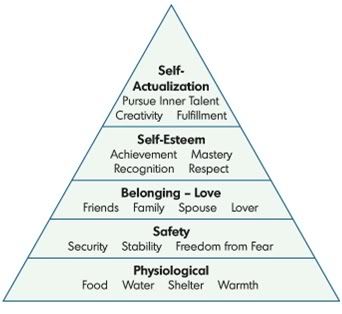
The Maslow’s needs hierarchy theory assumes that individuals are motivated if their needs are met. This theory shows how the satisfaction of needs is given in a progressive manner, as shown in the pyramid (image 1):
The McGregor's Theory X and Theory talk about two types of hypotheses, the theory X and the Theory Y. Theory X talks about lazy employees that dislike work and responsibility. The employees describe by this theory are also self-centered and individualistic. On the other hand, the Theory Y assumes that the employees enjoy to work, seek responsibilities and are self sufficient. Both theories recommend how to deal with the workers. The Theory X recommends that these kind of workers need money as a motivation, while theory Y explain that the perfect motivation with the workers is to convert the goals organization into individuals needs.
The Herzberg's two-factor theory tries to explain how to manage the work satisfaction and dissatisfaction. Herzberg also introduced the hygiene factor. If an organization fulfills all the needs related with the hygiene factor, avoid the employee dissatisfaction, but this does not indicate that the employee will be satisfied.
The Alderfer's ERG theory comes from the criticisms of the theory of Maslow. The main difference is the idea that the needs can be met at the same time, so various levels of need can cause motivation simultaneously.
The Alderfer's ERG theory comes from the criticisms of the theory of Maslow. The main difference is the idea that the needs can be met at the same time, so various levels of need can cause motivation simultaneously.
The last one theory is the McClelland's need theory. McClelland's explained that individuals manifest 3 needs. The need of achievement, the need of power, and the affiliation need. According to the needs, the author recommends how to motivate the person.
Questions
1. What are the Hawthorne Studies? Explain its importance for studying motivation at the workplace and its influence over diverse motivation theories. (Include key findings and limitations)
The Hawthorne Studies began as an experiment to measure if the lighting of the workplace increased employee productivity. This experiment result showed that illumination could affected the productivity improvement, concluded that workers improved their performance thinking they were being observed.
This effect is demonstrated as working conditions influence the behavior of the individual in the organization. This experiment showed how there are factors that motivate employees, and like The Herzberg's two-factor, other factors that involve only the employee to work without disgust but not with pleasure. Features such as lighting, moments of rest, and water, give comfort to the individual in his work area, but are not motivators, while the need for recognition, of belonging and empowerment are.
Another important finding relates to the role of manager or supervisor as a leader. That employees feel they are being studied can lead to two types of results, feel depressed or who feel they are a fundamental part of the organization. Everything depends on how the leader to communicate with subordinates.
The Hawthorne Studies are also related with the McGregor's Theory X and Theory Y. Cause understand what kind of workers integrated the organization is a fundamental key factor. Not all workers are motivated by the same things. As Elton Mayo discovered in the Hawthorne effect, pay is a relatively low motivator.
2. Based on the class activity about "Flight 001: Motivating Employees", please answer the following question: ¿Which motivation theory do you think has the most relevance for understanding the behavior of Griffin and fostering her motivation at work?
According to the "Flight 001: Motivating Employees" the theory that could explain better the success in the way that the organization is motivating their employees is the McGregor's Theory Y.
Emily Griffin is the perfect example of an employee that already fulfills the lower order needs, and is trying to fulfill the higher order needs. Ms. Griffin seeks for responsibility, new challenges, and the opportunity to improve her knowledge, and is totally capable of contribute to the organizational goals. That is why she is enjoying working in Flight 001.
As is described in Theory Y, the main source of motivation, for employees like Ms Griffin, is to contribute to the goals of the organization using their knowledge. Such workers enjoy meet their empowerment needs.
References
- http://courses.washington.edu/inde495/lece.htm
- Viorel, Lefter, Manolescu Aurel, Marinas Cristian Virgil, and Puia Ramona Stefania. 2009. "EMPLOYEES MOTIVATION THEORIES DEVELOPED AT AN INTERNATIONAL LEVEL." Annals of the University of Oradea, Economic Science Series 18, no. 4: 324-328.
Image taken from:

